Farmers, researchers, and local stakeholders come together through a Farm Field School to explore agroecological innovations for more sustainable rice production.
On 23 April 2026, the Uvira Living Lab hosted a Farm Field School (FFS), bringing together farmers, researchers, extension agents, and local stakeholders from the sites of Katogota and Kamanyola. The event provided a valuable opportunity for participants to learn from ongoing field experiments, exchange experiences, and strengthen their understanding of agroecological practices for irrigated rice production.
Designed as a participatory learning platform, the Farm Field School encouraged stakeholders to jointly observe, analyze, and discuss innovations being tested within the Living Lab. A central feature of the activity was the comparison of two contrasting rice fields—one well-managed and another facing management challenges. This cross-visit approach enabled participants to identify key factors influencing crop performance and stimulated discussions on good agricultural practices, including water management, weed control, soil fertility, and pest management.
Participants also assessed several experimental treatments being tested within the Living Lab. These included different combinations of mineral fertilizers and organic matter, as well as a comparison between Rocket, a conventional chemical pesticide, and biopesticide-based alternatives. By observing crop performance and discussing the strengths and limitations of each approach, participants gained valuable insights into sustainable pest management options and their potential role in reducing dependence on chemical inputs.
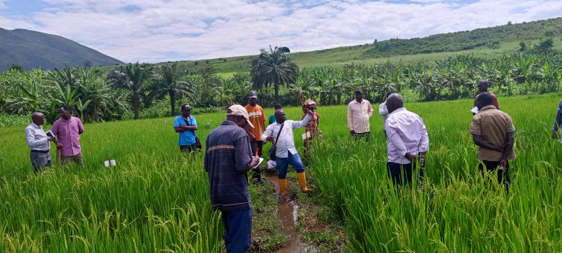
Field observations highlighted the importance of effective water management and regular weeding in maintaining healthy rice crops. Preliminary results suggested that combining mineral fertilizers with organic matter can enhance crop performance and contribute to improved soil health. At the same time, discussions around the Rocket and biopesticide treatments encouraged participants to reflect on the environmental and agronomic benefits of adopting more sustainable crop protection strategies.
Beyond the technical learning, the Farm Field School fostered collaboration and knowledge sharing among stakeholders. Farmers exchanged practical experiences, researchers provided scientific insights, and participants collectively reflected on strategies for improving rice production systems. By promoting hands-on learning, dialogue, and collective experimentation, the activity demonstrated the value of participatory approaches in supporting agroecological transition and building more resilient and sustainable rice farming systems in the Uvira Living Lab.
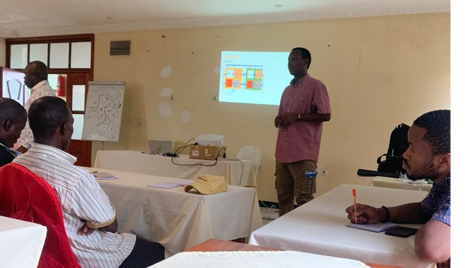
Through initiatives such as this, the CANALLS Project continues to empower local communities, strengthen innovation networks, and support the co-creation of solutions for sustainable agricultural development.