
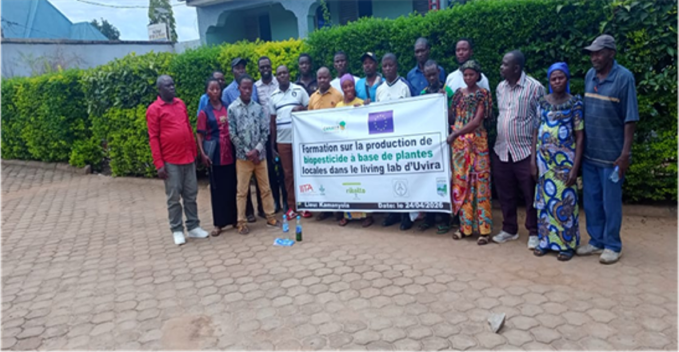
CANALLS partners have organised practical training for stakeholders in the Uvira Living Lab on producing and using biopesticides made from locally available plants. The activity aimed to promote accessible and environmentally friendly alternatives to chemical pesticides while supporting more sustainable rice production.
Rice cultivation plays an important role in the livelihoods of farming communities in Uvira, in the Democratic Republic of the Congo. However, local production is affected by several challenges, including pests and diseases, declining soil fertility and a heavy reliance on chemical pesticides.
To help address these challenges, CANALLS partners APDIK, RIKOLTO, IITA and INERA organised a training course for farmers and other Living Lab stakeholders on the production and use of plant-based biopesticides.
Developing practical skills in natural pest management
The training aimed to enhance participants’ knowledge and practical skills in the agroecological management of rice crops. In particular, it enabled participants to:
- better identify the main pests and diseases affecting rice;
- understand the principles and benefits of biopesticides;
- learn the different stages involved in producing biopesticides from locally available plants;
- explore alternatives to chemical pesticides; and
- share and promote these practices within their communities.
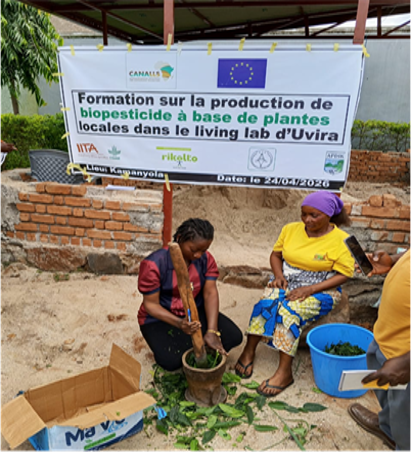
The activity followed a participatory approach combining theoretical presentations, discussions and practical demonstrations. After an introduction to agroecology, the main pests affecting rice and the benefits of biopesticides, participants became directly involved in collecting and preparing the plant materials needed to produce the biopesticide.
The discussions were conducted mainly in Swahili, making the technical content more accessible and encouraging farmers’ active participation. The training also created a space for farmers, researchers and project partners to exchange experiences and recognise the value of local knowledge related to natural pest-management practices.
Turning local plants into crop-protection solutions
During the practical demonstration, participants collected 500 g of lemongrass leaves, 500 g of papaya leaves and 1,000 g of Cedrela odorata leaves. The materials were then processed through the different preparation stages, producing 1.5 litres of concentrated biopesticide for use in the demonstration. This hands-on exercise helped participants understand both the preparation process and the potential of locally available plants as resources for protecting rice crops.
Using local plant materials can offer farmers a more accessible and environmentally friendly approach to pest management. It can also help reduce dependence on chemical pesticides and encourage practices that contribute to healthier ecosystems and more resilient farming systems.
Learning and innovating together
The activity reflects the CANALLS approach to agroecological transition: building on local realities, strengthening stakeholders’ capacities and collectively testing solutions adapted to farmers’ needs.
By enhancing the technical skills of Uvira Living Lab stakeholders, the training supports the wider adoption and dissemination of locally adapted agroecological practices for more sustainable and resilient rice production.
The experience in Uvira shows that the agroecological transition depends not only on access to suitable technical solutions, but also on the capacity of farming communities to learn, experiment and innovate together.