The CANALLS Expert Panel in Cameroon brought together our partners from the African Agricultural Technology Foundation (AATF), the Institute of Agricultural Research for Development (IRAD), and external local stakeholders on 22 and 30 April 2026 in Yaoundé to discuss agroecology policy and identify key challenges, opportunities and priority actions for advancing agroecological transitions in the country.
The discussions focused on the policy and institutional conditions needed to support agroecological transitions in Cameroon. Participants reflected on the pressures facing African agriculture, including population growth, climate change and declining agricultural productivity, and considered the role of agroecology in strengthening food and nutrition security, livelihoods and resilience. They also recognised the ongoing development of the National Agroecology Strategy and the recently enacted Organic Farming Law as important opportunities for supporting agroecological transitions in Cameroon.
Drawing on policy-relevant evidence generated through the CANALLS project and validated through the Cameroon Expert Panel process, participants identified a number of key barriers to agroecological transitions. These included the absence of premium markets and market incentives for agroecological products, particularly agroecological cocoa, weak coordination and communication among actors and initiatives promoting agroecology, and weaknesses in public extension systems and farmer training on agroecological practices.
The panel also identified several strategic opportunities that could help accelerate the transition, including the development of the National Agroecology Strategy, the new Organic Farming Law, existing coordination platforms such as the Comité Cacao Durable, financial mechanisms supporting agroecological transition, and international market and regulatory opportunities linked to sustainable and deforestation-free production.
The panel agreed on priority areas for policy action:
- Finalising and operationalising the National Agroecology Strategy and strengthening the legal and institutional framework for agroecology
- Strengthening existing coordination platforms, including the Comité Cacao Durable, to support multi-stakeholder engagement
- Developing certification standards and market incentives for agroecological products, particularly cocoa, while aligning EUDR implementation with national agroecological transition objectives
- Improving communication and information sharing on agroecological initiatives, practices and innovations
- Strengthening agricultural extension, farmer training and partnerships between government, research organisations, the private sector and farmer organisations.
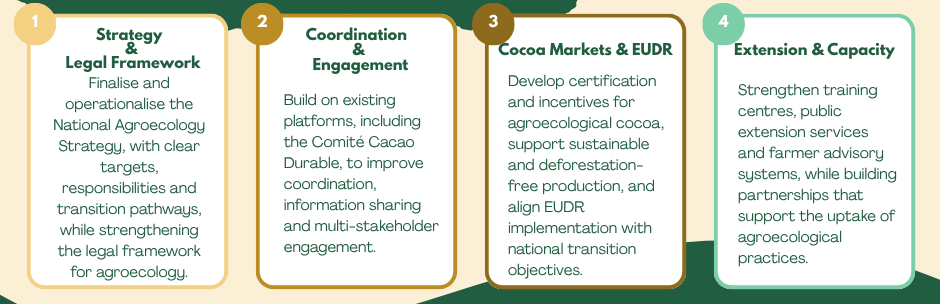
Participants also highlighted the importance of creating a clearer legal and institutional framework for agroecology, strengthening multi-stakeholder coordination, and aligning market and regulatory mechanisms with national agroecological transition objectives.
The meeting concluded with strong interest in continuing to work collaboratively with relevant stakeholders to support implementation of the proposed policy actions and address the challenges identified.