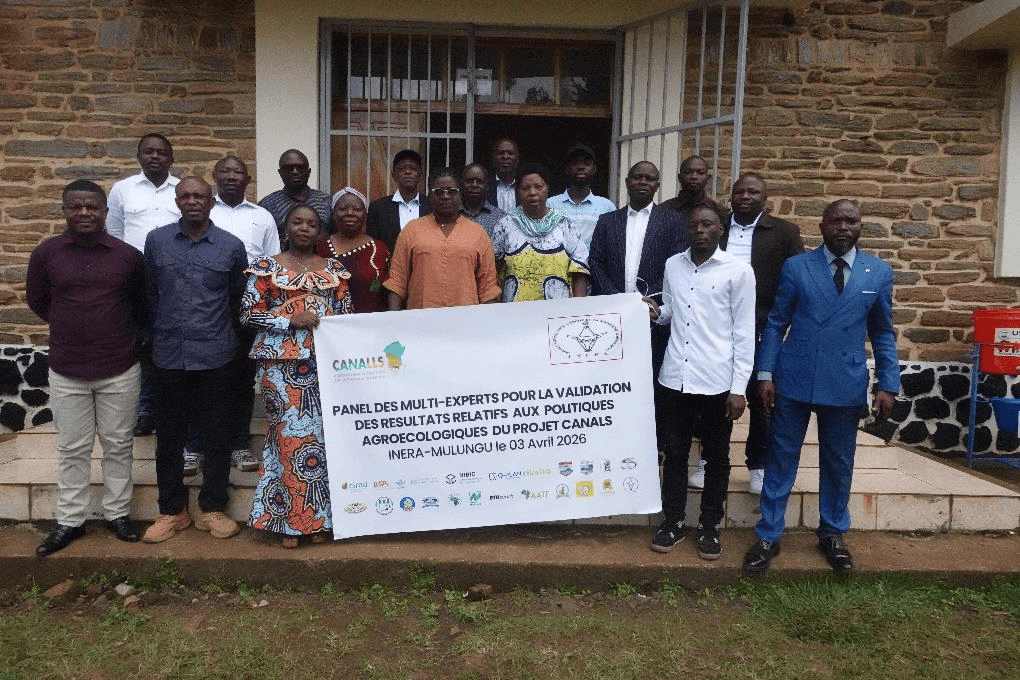
The CANALLS Expert Panel in the Democratic Republic of the Congo (DRC) brought together the African Agricultural Technology Foundation (AATF), the National Institute of Agronomic Studies and Research (INERA), and other CANALLS partners on 3 April 2026 at the INERA Mulungu Research Center in South Kivu to discuss agroecology policy and identify key challenges, opportunities and priority actions for advancing agroecological transitions in the country.
The discussions focused on the policy and institutional conditions needed to support agroecological transitions in DRC. Participants reflected on the pressures facing African agriculture, including population growth, climate change and declining agricultural productivity, and considered the role of agroecology in strengthening food and nutrition security, livelihoods and resilience.
Drawing on policy-relevant evidence generated through the CANALLS project and validated through the DRC Expert Panel process, participants identified several key barriers to agroecological transitions. These included the absence of premium markets for agroecological products, particularly cocoa, the lack of explicit agroecology frameworks, limited access to land, credit and training, weak governance and policy coordination, dependence on donor-funded programmes, and gaps in institutional capacity and knowledge systems.
The panel also identified strategic opportunities to accelerate the transition, including existing national agricultural and climate policy frameworks, the Kivu-Kinshasa Green Corridor Initiative, the Network for Food Security and Sovereignty in the DRC (RSSAC), and opportunities for government, climate and private sector financing.
The panel agreed on priority areas for policy action:
- Developing a national agroecology framework and strengthening multisectoral coordination and policy coherence.
- Raising awareness and promoting agroecological products and local experiences.
- Increasing financing and investment through targeted subsidies, agricultural credit, microfinance and public-private partnerships.
- Strengthening agricultural extension, education, research and training on agroecological practices.
- Establishing agroecological innovation platforms and improving monitoring and evaluation systems.
Participants also highlighted the importance of strengthening national institutions, supporting local agroecological initiatives and reducing dependence on food imports.
The meeting concluded with a shared commitment to work collaboratively with relevant stakeholders to support implementation of the proposed policy actions and address the challenges identified.